Euro-Mid
denounced Israeli warships' deliberate act of attacking and dumping Palestinian
fishing boats within the permissible fishing zone; endangering the lives of
fishermen and civilians onboard the boats.
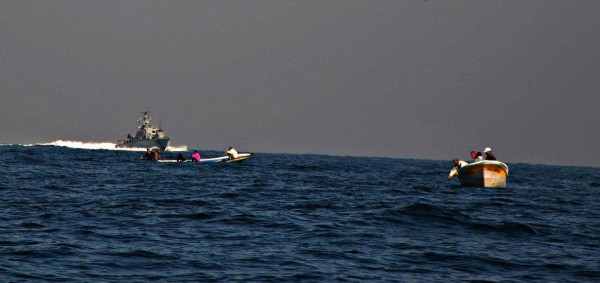
Euro-Mid Observer for Human Rights has distributed a video
recording captured by a journalist working for Media Town. The Video shows two
Israeli worships pursuing five Palestinian fishing boats owned by Gazan
citizens in the Gazan waters. The footage was recorded at 10: 30 Tuesday
morning, August 28.
Euro-Mid condemned the ruthless attack of the Israeli warships which
directly endangered the lives of Palestinian fishermen. Meanwhile, Euro-Mid
warned against the continuation of such barbarous practices in the absence of
international monitoring and deterrence.
Euro-Mid considered the attack one of the many systematic practices
used by Israel to destroy the fishing sector in the Gaza Strip, a sector that
sustains more than 70,000 residents at time of high levels of unemployment and
poverty due to Israeli siege.
Euro-Mid noted the attack occurred within the three nautical mile
limit set by Israeli military. The fishing boats shown in the video, in fact,
were chased at a distance of less than two nautical miles from shore which is an
evident violation of the international law and the Israel's own law.
A detailed report by Euro-Mid was issued last May concluded that
Israeli authorities did not only limit the permissible fishing zone, but also
intended to prevent a great number of fishermen( around 3600) from practicing
their own trade freely and safely, even within the permissible 3-mile limit,
using its warships.
Euro-Mid report documented an estimate number
of 150 violations per year committed by Israel against Gaza fishermen including
arbitrarily arrests and shootings, in addition to dumping, vandalizing, and
confiscating fishing boats.
I took this video this morning while I was in Soudania beach, north Gaza city. At about 10.50 am the two boats of the Israeli navy surrounded 6 palestinians fishing boats. Also, the Israeli navy shot at one of the palestinian boats with five bullets. After 15 minutes, the fishermen escaped and went back to the port of Gaza city.
The
fishing zone was supposed to be 20 nautical miles, according to the
Jericho agreements from 1994 (under the Oslo accords), then it was
reduced to 12 miles, to 6 miles and now to 3 miles since January 2009.
The marine 'buffer zone' restricts Gazan fishermen from accessing 85% of
Gaza's fishing waters agreed to by Oslo. Israel has been regularly attacking Palestinian fishermen within the purported 3 nautical mile fishing limit. The
livelihood of many Gazans relies on fishing and Israel has been using
live ammunition and water cannons to prevent fishermen from doing their
work.
This film, produced by the Union of Agricultural Work Committees in Palestine, looks at the impact of Israeli siege on Palestinian fishers and farmers in Gaza, and the fishers' and farmers' steadfastness and resistance on their land and the Gaza sea.
Fishers in Gaza are under assault daily, braving Israeli warships in
order to secure the products of Gaza’s Mediterranean seacoast, which
support the livelihood of over 70,000 Palestinians in Gaza. Since 2006,
the Israeli siege on Gaza has penned Gaza’s fishers into 3 nautical
miles of the shore – when most fishing requires at least a 10 mile
range, and even the 1993 Oslo accords secured 20 miles of fishing access
for Palestinian fishers. Gaza’s fishery has lost 85% of its income
because of the Israeli siege.
Jase Tanner, of the Vancouver Delegation to Gaza, filmed the
following dramatic footage during a trip out to sea during his time in
Gaza with a longtime fishing family, when their boat was fired upon by
an Israeli warship, their steering disabled as they attempted to quickly
sail toward shore. (Numerous fishers have been arrested and jailed, and
fishing boats confiscated, by the Israeli navy.)
This is the daily experience of Gaza’s fishers – most often unnoticed
and not filmed by international activists. Share this footage to inform
the world about what is happening to fishers in Gaza as they attempt to
live from their own sea that has supported Gaza throughout history:
Fishermen in the Gaza
Strip have to deal with more than just the typical occupational hazards. Instead of just worrying about holes in their
nets or fuel for their motors, fishermen, like Fadel Abuwarda (30), also have to
think about the regular illegal attacks, arrest, detention and confiscation of
their fishing equipment they are subject to by Israel’s naval forces. It does not matter whether they are within
the 3 nautical miles that Israel has unilaterally declared Gazans are allowed
to fish in. Nowhere in the Gaza Sea are
fishermen safe.
On 20 June 2012, at
around 19:30, Fadel and a friend came under Israeli fire while they were
fishing a mere 1700 meters from the Gaza Strip shore: “We had just thrown our
nets in the water when we saw an Israeli gunboat speeding towards us. We then tried to pull our fishing nets out of
the water and retreat, but they started shooting at us. Each time we made attempts to pull the nets
in, they fired at our boat.”
After opening intensive
fire on the 2 men, the initial Israeli gunboat left and was replaced by a
number of other smaller gunboats with soldiers on board: “The soldiers ordered
us to remove our clothes and jump into the water. We were crying and trying to talk to
them. We told them we were just poor
fishermen trying to make a living for our families. We begged and cried, but they would not want
to listen to anything we had to say.”
Fadel finally decided
to comply with the soldiers’ commands to remove his clothes and jump into the
sea: “I asked my friend to pull the nets out and turn back. He is young, only 19, I thought that they
would let him go back if I offered myself up, but they refused and started
firing at him again. He also removed his
clothes and jumped into the water.”
The
2 fishermen were
then pulled out of the water by the soldiers and onto one of their small
boats
that was circling around their fishing boat.
Fadel’s brother and cousin, as well as 2 other fishermen, were
working nearby on their own boats. A few
minutes later, all 4 of them were arrested and brought onto the small
Israeli
gunboat beside Fadel and his friend: “There were now 6 of us. We were
all blindfolded. They tied our hands and feet and forced us to
sit on the floor. We were all in our
underwear and sat on something that felt like a leather surface. It was
very uncomfortable. We asked them to give us our clothes, but
they only gave them to 4 of us. My
brother and cousin were not given anything to wear It was very
humiliating for
all of us.”
The
6 fishermen were
subsequently taken to the Ashdod port in Israel: “They removed our
blindfolds
and we saw many soldiers waiting for us in Ashdod. I kept wondering why
there were so many of them. We had not done anything wrong. We had
been fishing around 1700 meters from
the shore. We had not even gone near the
3 nautical miles. I just kept telling
them that we are poor fishermen trying to make a living.”
Fadel and the 5 other
fishermen were detained in a cell and each was questioned separately for
approximately 30 minutes. It was
at around midnight when they were left to sleep on mats in the cell: “In the
morning, they blindfolded us again and handcuffed us, then drove us to the Erez
checkpoint and released us there. They
did not tell us anything about our boats and fishing nets, or where we could
find them.”
For Fadel, losing his
only source of livelihood has caused him and his family huge financial strain:
“The losses that my brother and I incurred from losing 35 fishing nets and our
boats amounts to almost 30,000 USD. Until now, I have not heard about my boat and
nets. They are not where we left them
the night we were arrested and currently I have no money to replace them. One of my other brothers is also a fisherman,
so he took pity on me and hired me to work for him. I earn 20- 40 shekel each time I help him
fish. When I had my own boat, I used to
make 200 shekel. I barely have anything
to take home. My wife says I do not bring
money home anymore and this is hard for me.”
As a result of the loss
of his livelihood, Fadel is bracing himself for a bleak and uncertain future:
“I do not know if I will ever get my fishing equipment back. A few days before this incident, they fired at
me and another fisherman on my boat then held us under the sun for about 2
hours for no reason. They always do this
to poor people trying to make a living.
This is my work, my only occupation and my life. What else for me then? It has reached a point where I cannot even
bring myself to be scared anymore. Let
them arrest me if they want, after all, I will just be one of the many
Palestinians locked up in Israeli prisons and if they kill me while I am
fishing - let it be.”
The direct targeting of civilians and
civilian object constitutes a war crime, as codified in Article 8(2) (b) (ii)
of the Rome Statute of the International Criminal Court. The subsequent enforcement against private
property in the buffer zone results in Palestinians being unable to use the
property necessary for the production of food, violating numerous human rights
provisions, including the right to adequate food contained in Article 6 of the
International Covenant on Civil and Political Rights. Israel’s actions against the fishermen is
also a violation of their right to an
adequate standard of living, as codified in Article 25 of the Universal
Declaration of Human Rights and Article 11 of the International Covenant on
Economic, Social and Cultural Rights.
To see a video narrative given by FadelAbu Warda please click
here.
The Israeli navy attacks the Gaza-based 'Oliva' human rights monitoring
boat with a water cannon and chases them into the Israeli-imposed
'buffer zone'. They then tell the crew and captain to stand at the front
of the boat to be 'arrested' because they had crossed into the no-go
zone.
16 April 2012. In the early evening i met the fishermen at the Gaza
port. As the sun began to set we headed to the sea. It was a beautiful
clear evening, the sun was beginning to set and gentle swells rocked the
boat. Not only were we fishing, but we would challenge the arbitrary 3
mile limit imposed by Israel on all boats in Gazan waters.
On April 5, 2012, me and Derek sailed again on a trawler with the fishermen during the night.
We were at about 100/150 meters away from the 3 miles limit.
The Israeli nave came quickly and started creating waves and shooting.
We had to came back at about 2 miles offshores.
Restrictions
on the fishing zone are of extreme significance to Palestinian
livelihoods. This area was supposed to be 20 miles according to the
Jericho agreements from 1994 (under the Oslo accords), then it was
reduced to 12 miles, to 6 miles and now to 3 miles since January 2009.
The marine 'buffer zone' restricts Gazan fishermen from accessing 85% of Gaza's fishing waters agreed to by Oslo.
Israel has been regularly attacking Palestinian fishermen within the purported 3 nautical mile fishing limit.
The
livelihood of many Gazans relies on fishing and Israel has been using
live ammunition and water cannons to prevent fishermen from doing their
work.
The Israeli Siege continues after more than 4 years, limiting the sea area available for the Gaza population.
3 December 2011 | Civil Peace Service Gaza
On Saturday, 3 December 2011, the Israeli navy harassed Palestinian fishermen and international observers three miles off the coast of Gaza.
Israeli military harassing on the high seas - Click here for more images
Between 10:00 and 11:00 am, two warships repeatedly charged a group of seven hasakas, one trawler, and the Civil Peace Service Gaza boat Oliva.
Finally, after 3 years of efforts from international activists (ISM, Free Gaza Movement, CPSGaza), Amnesty International decided to pay some attention on the issue of Gaza fishermen. In the episode 7 of Amnesty TV, by Amnesty UK, there is a 3:51 part concering Gaza fishermen. (Go to 1:47).
But all we see on this video is an Israeli gunboat aproaching and just... calling 2 fishermen in a small boat, accompanied by foreign hebrew speaking journalists, to go closer to the beach.
Is it just this what is really happening to the Gaza fishermen?
Where are the images of Gaza fishermen killed by the Israeli Navy?
Mohammed Nadi Saleh al-'Attar (picture from In Gaza blog)
Where do we hear the voice of the families of killed fishermen?
Where do we see in Amnesty´s video, the injured fishermen?
Where do we see in Amnesty's video theGaza fishermen mutilated by Israeli gunfire?
Where do we see in Amnesty's video the fishing boats with dozens of bullet holes?
Where do we see in Amnesty's video, the fishing boats incinerated after Israeli shelling?
Where do we see in Amnesty's video, the fishing boats rammed by Israeli gunboats?
Where do we see in Amnesty's video, the Israeli gunboats shooting at the nets of the fishing boats? And bullets found inside the fishing boat...
Where do we see in Amnesty's video, the Israli gunboats throwing explosives near the fishing boats and spraying the fishermen and the catch of fishes with unknown biological or chemical liquid?
Where do we see in Amnesty's video, the Israeli gunboats firing shells, machinegun fire, tracer bullets and water from watercannon?
Where do we see in Amnesty's video, international activists injured by shattered glass during watercannon attacks?
Where do we see in Amnesty's video, the international accompaniment boat Oliva, attacked with watercannon by Israeli gunboats?
Where do we see in Amnesty's video, the Gaza fishermen who have been abducted, detained and abused, in order to become spies?
If small organizations with few activists like ISM, Free Gaza Movement or CPSGaza and a few Palestinian or foreign journalists, have managed to show the real life of Gaza fishermen, why can't the biggest human rights organization in the world, with 3 million members and a huge budget, do the same? And why Amnesty International didn't use some of this footage for the report on Gaza fishermen?
After seeing all these images, you can understand why Amnesty's report (of Israeli Navy just... shouting to the Palestinian fishermen), can be considered rather a "whitewash" of Israeli Navy's crimes, than a decent human rights report...
kaxlan2009
(The opinions expressed in this post are of kaxlan2009, the administrator of Fishing Under Fire, and do not necessarily reflect the opinions of other international activists who have worked or still working with Gaza fishermen)
Between December 2010 and January 2011 the Israeli army's attacks on Gaza's waters caused at least 14 arrests, among them two children, the confiscation of 2 boats and damages in equipments.
This documentary is part of a project implemented by UAWC and the APY Foundation in the Gaza Strip for the rehabilitation of fishing boats, distribution of equipment, and trainings in human rights and advocacy.
A total of 886 families dependent on fishing benefited from the project, which had the financial support of the Spanish Agency for International Cooperation for Development (AECID).
This documentary is the sole responsibility of its authors and the UAWC, and does not reflect necessarily the opinion of the AECID.
20, 12, 6, 3 nautical miles. Palestinian fishermen in the Gaza Strip see how their working area shrinks more and more. Their boats sail up and down the coast, finding little fish in highly polluted waters. They make a living between shifting boundaries imposed by the gunfire of the Israeli army. The sea that always fed them now has gates that cannot be crossed.
Video of our international human rights observation boat outrunning the Israeli navy as it attempts to fire a watercannon on Palestinian fishing boats under 3 miles out to sea.
Publicly, Israel ‘allows’ fishermen in Gaza 3 miles in which to make a living. Today, as happens on most days they attacked 5 fishing boats at around 2.5 miles out, pursuing them until we were well under 2 miles away from the Gaza shore. For once, this regular occurrence was caught on camera.
For the first time in our boat’s history, we managed to escape. This is what happened last time I was in this position. Updated on November 26, 2011
This video combines Al-Haq's visual documentation with satellite imagery to create virtual tours of the human rights violations commited in the occupied Palestinian territory.
Each tour is designed to recreate the experience of making a field visit, providing everyone with the opportunity to see the on-the-ground reality of the occupation.
This tour shows how Israeli occupying forces often use live ammunition to enforce the buffer zone in the Gaza Strip, both on land and at sea. Since the beginning of 2010, stone-collectors have been increasingly under attack by Israeli soldiers. In 2009, Al-Haq documented seven cases of rubble collectors injured by live ammunition in the vicinity of the buffer zone, whereas this number was 10 times higher during 2010, when 68 rubble collectors, of whom 15 children, were shot. Fishermen are also targeted on a daily basis with many incidents occurring outside the buffer zone. In some cases, the Israeli occupying forces fire rockets and shoot bullets at the Palestinian boats at sea or on the shore in order to destroy them, thus preventing the fishermen from working.
24 July 2011 | The Guardian, Harriet Sherwood
Hani al-Asi, a fisherman since the age of 11 and a father with 12 mouths to feed, had just begun throwing his lines into the Mediterranean when an Israeli gunboat sped towards his traditional hasaka.
With a machine gun mounted at the rear and half a dozen armed soldiers on the bridge, the navy vessel repeatedly circled the small fishing boat. The rolling waves caused by the backwash threatened to swamp it.
Asi had stopped his boat over an artificial reef created by dumped cars to attract the dwindling fish population. He was just beyond the limit of three nautical miles from the Gaza shoreline set by the Israeli military for Palestinian fishermen, beyond which they are forbidden to fish for “security reasons”.
“We see them every day,” he said, shrugging at the gunboat’s presence. “I got used to this. Every day they are around us – shooting, damaging the boat, sometimes people are injured. If we were scared, we wouldn’t fish. But we have nothing else to do.”
With the boat rocking forcefully, the gunboat’s crew addressed Asi in Arabic through its loudspeaker. “You are in a forbidden area. Go back.” Asi pulled in the lines and headed back to port.
“The best place to fish is more than 10 miles out,” he said. “But every time we exceed three miles, they shoot at us, use the water [cannon], take the nets. Even today when foreigners are with us, they were trying to tip the boat over.”
Under the 1993 Oslo accords, Palestinian fishermen were permitted to fish up to 20 nautical miles off the coast of Gaza. Over the past 18 years, the fishing area has been successively eroded, most recently in 2007 when Israel imposed a limit of three nautical miles as part of its land and sea blockade of Gaza after Hamas took control of the territory.
But fishermen and human rights groups say that, since the war in Gaza in 2008-09, the Israeli military regularly enforces a limit even closer to the shore.
The restriction has devastated Gaza’s fishing industry. “It is a catastrophic situation,” said Khalil Shaheen of the Palestinian Centre for Human Rights. “Sixty thousand people are dependent on [the fishing industry], and 85% of daily income has been lost.”
Fishermen on both sides of the three-mile limit, he said, were subjected to harassment, live fire, confiscation of boats and nets, and water cannon, sometimes impregnated with foul-smelling chemicals.
Since early June, a coalition of Palestinian and international organisations under the umbrella of Civil Peace Service Gaza has been monitoring encounters between fishermen and the Israeli military from its own boat, the Oliva.
But in the past fortnight, the Oliva itself has become a target for the Israeli navy, with repeated assaults on it by military vessels. Last Wednesday, the Guardian hired a boat to accompany the monitors plus a handful of hasakas out to sea.
At around the three-mile limit, the small flotilla was approached and repeatedly circled by two Israeli gunboats. The engines of the hasakas were cut as the waves caused by the gunboats’ backwash rose and fell. After about 20 minutes, the gunboats withdrew as a third military vessel, deploying water cannon, arrived.
A powerful jet of water was targeted at the Oliva, causing the boat to rock dangerously and drenching those aboard. After repeated dousings, the Oliva’s captain ordered the four passengers to clamber on to an adjacent hasaka, fearing his boat was about to sink. As the Oliva’s engine was hit by the military vessel, he too was forced to abandon ship.
From a distance it seemed impossible that the Oliva would not go under. But its captain and other fishermen managed to secure a rope to try to tow it back to port. The military boat followed the Oliva and the other boats at some speed, still firing its water cannon, for several minutes.
According to Salah Ammar, the Oliva’s captain, the boats were within the three-mile limit. “We don’t even reach two miles before they chase us with guns and water [cannon],” he said.
However, GPS co-ordinates taken by the Guardian during Wednesday’s encounter showed the position of the boats to be outside the permitted zone.
In a statement, the Israeli Defence Force said: “The ongoing hostilities between Israel and Palestinian terror organisations create significant security risks along the coast of the Gaza Strip. Due to these risks, fishing along the coasts has been restricted to a distance of three nautical miles from shore. Fishermen in Gaza are aware of these restrictions as they have been notified of them on numerous occasions. The restrictions and their enforcement by the Israel navy are in complete accordance with international law.”
The United Nations and human rights organisations say the fishing restriction is collective punishment in violation of international law.
Shaheen rejects Israel’s justification. “The Israeli navy has never found evidence that fishermen involved in violations have been involved weapons smuggling,” he said. The “environment of daily harassment” was part of Israel’s “illegal collective punishment and closure of Gaza”.
The Oliva’s engine was damaged in Wednesday’s encounter but Ammar was planning to go out to sea again the next day if he could locate the parts he needed to fix it. “Every time I know what will happen. They will shoot water on me, fire bullets. But I get hundreds of calls asking, ‘When will you go out?’” The fishermen, he says, want the protection they believe is afforded by the presence of international monitors on board the boat.
Asi, back at the port after his aborted fishing trip, was puzzled by the military’s aggression towards fisherman whose faces, he says, the soldiers must recognise after repeated encounters. “The point is not security for the Israelis. They know everything. They arrested many of us and searched many boats and never found anything.”
His morning’s haul consisted of one large sea bass, sold for 150 shekels, and three smaller, worthless fish. After deducting 50 shekels for fuel, 50 shekels for bait, and 10 shekels to put aside for his boat’s maintenance, he and his assistant pocketed 20 shekels (£3.60) each for their day’s work.
Would he be going out again the next day? “Inshallah [if God wills it]. This is the only source I have to feed my family.”
Footage of the second water-cannon attack by the Israeli navy against the Civil Peace Service Gaza boat “Oliva” on Thursday, July 14, 2011. The camera used was lost in the sea when the crew evacuated the “Oliva,” recovered in a fishing net, and returned on Wednesday, July 20.
Emboldened by the ‘Freedom Flotilla’s’ attempt to bring humanitarian aid to Gaza by sea, some Gazan fishermen have been trying to sail beyond the three nautical mile limit imposed by Israel.
The Oslo Accords allowed fishermen to work within 20 nautical miles of the coast, but Israel later reduced the limit on the premise that allowing more space will potentially allow Gazans to receive smuggled weapons.
Israel responds to the fishers’ actions with water cannons, and sometimes with live gunfire.
Al Jazeera’s Nicole Johnston reports from Gaza.