26th January 2009 - Gazan territorial waters: Despite a ceasefire, and despite the fact that their target was a civilian vessel, the Israeli navy open fire on a Palestinian fishing boat to the severe injury of the captain Alaa Alhabel.
Thursday, January 29, 2009
Israeli navy wounds Palestinian fisherman
Posted on the ISM webpage on: January 29, 2009
Updated on January 29, 2009


Saturday, January 24, 2009
It’s a ceasefire…just not on the beach, not in your home
Eva Bartlett | In Gaza
January 24, 2009, 7:52 am
Two days later, at 1:00pm, Israeli soldiers fired on residents of Al Qarara, near Khan Younis, shooting Waleed al-Astal, 42, in his right foot.

January 24, 2009, 7:52 am
On the 5th morning after Israel declared a ‘ceasefire’, Israeli gunboats began shelling, as they had on several mornings since halting the 22 day air and land bombardment of Gaza. The shelling, which began just after 7:30 am off Gaza city’s coast, injured at least 6, including one boy with shrapnel in his head.
Yasser Abed, 15, came out from his home in Gaza’s Beach camp, on the coast, to see where the shelling was occurring. A shard of shrapnel lodged in his forehead.
Nisreen al Quqa, 11, was out earlier, before the navy began to fire towards Palestinian fishermen. She and her brother were walking on the beach when the firing started. A piece of shrapnel lodged in her right calf muscle.
Other injuries included a 14 year old male who was hit in the thigh by one of the shrapnel fragments, a 35 year old male also with a shrapnel injury, and a 4 year old girl with a head wound from flying shrapnel.
To the east of Gaza city, in the Sheyjaiee district close to the eastern border, also on the same day, 7 year old Ahmed Hassanian was outside his house with friends around 9:45 am. He lies now in critical condition in Shifa hospital’s ICU, a bullet still lodged in his brain and with such brain hemorrhaging and damage that he is expected to die shortly.
Mu’awiyah Hassanain, the director of Ambulance and Emergency Services, reports shelling in the northwestern coastal area of As Sudaniya on the same morning, saying five fishermen were injured in the attacks.
Israeli warplanes, on the first day of the ceasefire, flew extremely low and loudly over areas of Gaza, leaving residents expecting the worst. Drones capable of photographing and of dropping lethal, targeted missiles, continued to circle in Gaza’s skies for the first 3 days after the tanks retreated and the air-bombing ceased. At 8:30 am, one of these drones dropped 2 missiles in the Amal area east of Beit Hanoun, wounding a woman and an 11 year old child, who later died of her injuries.
The Palestinian Centre for Human Rights (PCHR) reports further violations of the cease-fire.
At 10:40, Israeli troops killed Maher abu Rjaila, 23, shooting him in the chest as he walked on his land east of Khan Younis city.Two days later, at 1:00pm, Israeli soldiers fired on residents of Al Qarara, near Khan Younis, shooting Waleed al-Astal, 42, in his right foot.
Israel’s assault on Gaza has killed at least 1, 330, with as many as 200 more bodies expected to be recovered from under the rubble of the over 5,000 destroyed houses and 20,000 buildings.
Dr. Fawzi Nablusi, director of Shifa’s ICU, said that of the cases in Shifa’s ICU, 90% were civilian, of these 50% were women and children. One of those civilians injured the day before Israel’s ceasefire was Mohammed Jarboua. Also from the Beach camp, the 21 year old is clinically brain dead, surviving only on mechanical life-support, after being shot in the head by Israeli naval forces.
The Director of Shifa hospital, Dr. Hassan Khalaf, and Mu’awiyah Hassanain confirmed that since the ceasefire began on January 18, three more Palestinians have been killed, and 15 more injured, 10 of those injured on January 22nd.
These ceasefire violations are not a new precedent, as during the 6 month ceasefire which began on June 19th, Israeli forces routinely targeted and fired upon fishermen and farmers along Gaza’s eastern and northern borders, injuring 62, according to Palestinian sources. During this period, 22 Palestinians were also killed, many of them members of resistance groups, and 38 fishermen and farmers were abducted. The truce period saw border crossings mainly closed, completely sealed them from November 4, 2008 with only the briefest of openings.
As the dust settles and noxious chemical fires continue to smolder, Gazans focus on their immediate needs: housing, food, and in many cases locating lost family members still under the rubble.
The root of the problem continues: the nearly 2 year old siege on Gaza, not relaxed under the 6 month ceasefire as agreed, and which had already decimated Gaza’s health and sanitation infrastructures, and had shattered the economy. From the ruins of Gaza, any signs of an end to the siege are far beyond the broken horizon.

Friday, January 23, 2009
[UN-OCHA Under-Secretary General visits wounded fishermen]
This is an extract from a Ma'an article posted on : 23 / 01 / 2009 Time: 16:09
The UN-OCHA Under-Secretary General also noted that on his visit to Ash-Shifa Hospital Thursday he witnessed the injuries of two fishermen who had been targeted by Israeli naval boat, still anchored offshore. “Things did not look very good” for the fishermen, noted Holmes, who could offer little indication of when the fishing industry would be allowed to re-open.
The UN-OCHA Under-Secretary General also noted that on his visit to Ash-Shifa Hospital Thursday he witnessed the injuries of two fishermen who had been targeted by Israeli naval boat, still anchored offshore. “Things did not look very good” for the fishermen, noted Holmes, who could offer little indication of when the fishing industry would be allowed to re-open.
Thursday, January 22, 2009
Israel’s navy shells Gaza, injuring seven
Date: 22 / 01 / 2009 Time: 09:57 | |
 |
| [Ma'anImages] |
Mu’awiyah Hassanain, the director of Ambulance and Emergency Services in the Palestinian Health Ministry told Ma’an that Israeli gunboats shelled the As-Sudaniya area northwest of Gaza City.
He said the wounded people were taken to Ash-Shifa Hospital in Gaza City.
Hassanain added that rescue teams are still working to recover the corpses, many of them now decomposing, of those killed in Israel’s three-week war on Gaza.
Separately, two Palestinians died in Egyptian hospitals where they were treated for wounds from Israel’s three-week offensive.
Medical officials identified them as: Tamer Omar Al-Louh, 22, from Gaza city and Azzam Mu’awad Ash-Shafe’y, 24, from Rafah.
The death toll from the war is now 1,330, with more than 5,000 injured.
Monday, January 19, 2009
Monday, January 12, 2009
TIMELINE OF GAZA MARINE ZONE, FISHERMEN AND NATURAL GAS DEPOSITS
Posted on the FGM website on: Monday, 12 January 2009 21:55
Link leading to a Schermerhorn radio interview on the subject http://citizenreporter.org/2009/01/bm292-the-battle-for-gaza-gas-reserves/
BACKGROUND: There is an historical connection between the Gazan community and the off shore fishery. In recent times some 3000 fishermen in over 700 boats made their livelihood in the waters off the shores of Gaza. Before 1978 when the fishing area included the sea off the Sinai coastline the area covered some 75,000 square kilometers.
The larger boats are about 20 meters in length and usually carry a crew of 7. They are typically trawlers using downriggers to lower their nets to the ocean bed. Currently their main catch is bream or sardines that average between 8 and 14 inches. The smallest craft are rowboats normally used to deploy nets a few hundred meters off shore. The nets are then hauled in by hand from the beach. These catches are very modest.
After the 1994 GAZA-JERICHO AGREEMENT the fishermen were free to use a corridor extending 20 nautical miles from the Gaza shore bounded by restricted zones to the north and south abutting Israeli and Egyptian waters. After the UN's 2002 Bertini proposal the approved location was reduced to an area within 12 nautical miles of the coast. More recently the area available has been reduced to 300 square kilometers.
Beginning in late 2000 the Israeli military began a campaign of intimidation and harassment against the fishing boats that ventured near or beyond a 6 nautical mile limit. No formal notice or explanation was ever given to the Palestinians. Instead the regulation was written and enforced by Israeli machine guns and water cannons. At least 14 fishermen have been killed by the Israelis, over 200 injured and numerous boats damaged or impounded.
WHY?
In the late 1990's the British Gas Group (BG Group) discovered a vast deposit of natural gas under the waters off Gaza: Over 1 trillion cubic feet equal to 150 million barrels of oil was estimated to be there. A significantly smaller deposit was also found in nearby Israeli waters.
On 11/8/99 Chairman Yasser Arafat signed an agreement giving BG Group 90 percent interest and 10 per cent to Consolidated Contractors Company, an Athens based Palestinian entity connected to the PLO.
A final allocation of the rights continues to be contested between BG Group, Israel, Egypt and the Palestinians in obscured ongoing negotiations.
The Israelis began their program of killing and harassing the Gazan fishermen only after the discovery of the natural gas deposits. It is a reasonable assumption that the two events are linked: That the Israelis are asserting control over this resource valued at over 4 billion dollars; And that they are intent on denying any benefit to the Palestinians regardless of who controls Gaza.
TIMELINE:
-May 4, 1994: PLO Chairman Yasser Araft and Israeli Prime Minister Yitzhak Rabin signed The Gaza-Jericho Agreement. Article XI established three Maritime Activity Zones that extended out to sea 20 nautical miles from the coast of Gaza. Two narrow Zones running parallel to the boundaries of Egyptian and Israeli waters were designated No Fishing Areas. Under the terms of the Agreement the larger remaining Zone "will be open for fishing, recreation and economic activities." The Gazan fishermen operated freely for the next 6 years within this Zone with no major confrontations with the Israelis.
- Late 1990's: The British Gas Group (later BG Group) began explorations off the Israeli and Gazan coasts for natural gas. A modest deposit was found in Israeli waters close to the Gaza Marine Activity Zone. A significantly larger deposit was found in a section of this Zone centered some 10 to 15 nautical miles offshore. It was estimated that there were sufficient reserves to generate electric power for all Palestinian needs for a decade and still have surplus to export.
- July 25, 2000: Yasser Arafat walked out on the Camp David meeting.
- September 27, 2000: Yasser Arafat traveled 19 miles off the Gaza coast to light the first flare stack flowing from the natural gas. An Israeli oil consortium had contested the Palestinian rights to the gas but was overturned in an Israeli court. The initial agreement with the BG Group gave them 90 percent interest and 10 percent to Consolidated Contractors Company, an Athens based Palestinian group. They and the Palestinian Investment Fund (PIF) had the option to later assume up to 40 per cent interest.
Initially BG Group negotiated with Egypt to run an undersea pipeline designed to import the gas. Under pressure from Tony Blair BG Group was forced to negotiate with the Israelis instead. Those discussions, which centered over price, have been so long and contentious that BG Group closed their Israel office and again began dealing with Egypt.
- September 28, 2000: Ariel Sharon visited the Temple Mount despite warnings by Arafat and other leading Palestinians. The predictable riots and deaths following this provocation marked the beginning of 2nd Intafada. Sharon was elected Prime Minister in February 2001. He vowed that Israel would never buy gas from the Palestinians. After the outbreak of the 2nd Intafada the Israelis began an ever-tightening blockade of Gaza with fewer and fewer trucks allowed to enter.
- Late 2000: Attacks by Israeli patrol boats against Gazan fishing boats began and have continued to this day. These attacks began 5 years before Hamas freely won the legislative elections on January 25, 2006. It is apparent that these assaults on the fishermen had nothing to do with security or with Hamas. Instead it had everything to do with a 4 billion dollar resource belonging to the Palestinians.
- August, 2002: In response to a request from Prime Minister Sharon, the Secretary-General of the United Nations appointed Ms. Catherine Bertini as his Personal Humanitarian Envoy to asses humanitarian needs of the Palestinians.
At the end of her visit to the area she made numerous recommendations including one that dealt with the fishing boats. In her report she included a list of "Previous Commitments Made by Israel". Item 2 states: "The fishing zone for Palestinian fishing boats off the Gaza coast is 12 nautical miles. This policy needs to be fully implemented." But never was!
- Although the attacks occurred throughout the Maritime Activity Zone they were more common once a boat had passed the 6-mile limit. Most boats now carry GPS's in order to know their exact positions. Some captains are intimidated by the Israeli threat and turn back before crossing the line. Others go further despite the increased danger from the Israelis. The fishery closer to shore has collapsed after so many boats were forced to operate in such a limited area. In addition the waters near shore are polluted due to sewage pouring in from broken pipes. One more consequence of an infrastructure crippled by the Israelis.
Since the outset of these assaults at least 14 fishermen have been killed and over 200 injured. Boats continue to be damaged or impounded.
9/12/05 - Israel announced that it had ended the occupation of Gaza and withdrew its forces. It maintained control of land and sea-lanes as well as all border crossings on land.
1/25/06 - Hamas won 76 of 132 seats in the Palestinian Legislative Council in an open honest election. After a bloody battle with Fatah elements Hamas took control of Gaza. Israel and the United States branded Hamas a terrorist organization and have had no public contact with it thereafter. The restrictions at the border crossings were tightened further with severe limitations on the traffic of produce, materials, medicines and people. Anemia and malnutrition were widespread as a result.
Early June 2008 - Israeli Defense Minister Ehud Barak instructed the Israel Defense Forces to covertly prepare for an invasion of Gaza to be known as operation "Cast Lead".
June, 2008 -Israel contacted BG Group to propose reopening negotiations over the natural gas deposits. Actual negotiations overseen by Ehud Olmert were taking place in October, 2008. It appears that Israel wished to reach an agreement with BG Group before the secretly planned invasion began.
6/19/08 - Hamas and Israel signed a 6-month truce agreement calling for cessation of rocket firings by Hamas and military incursions by Israel. In May over 300 rockets had been fired. In September only 5 to 10 were fired.
Hamas was lead to believe that significant increase in shipments would be allowed to enter Gaza. Before the truce roughly 70 trucks were allowed to bring provisions into Gaza each day compared with some 900 permitted before the Israeli clamp down in 2000. Hamas believed that a similar flow of traffic would be restored. Instead Israel allowed only an increase from the 70 to 90 trucks.
11/5/08 - IDF forces killed 6 Palestinians while supposedly searching for a tunnel passing under the border. In effect the truce was over after this provocation. During the next 5 weeks 237 rockets were fired into Israel compared with the 5 to 10 fired in September. The increase in rocket fire was Israel's public justification for launching the long planned "Cast Lead" invasion.
11/18/08 - An Egyptian court ordered the government to stop shipping natural gas to Israel. Under a 2005 agreement Egypt agreed to deliver 1.7 billion cubic meters of gas to Israel over a 15-year period. The gas began to flow in May, 2008. A lawsuit followed seeking to bar delivery since the Parliament had not given its approval. The court supported the lawsuit and its findings are being appealed. The potential cutoff of the gas from Egypt gave Israel even more incentive to take control of the Gaza Marine deposits and to deny any benefits to Palestinians whether Hamas or Fatah.
11/18/08 - Israeli naval vessels attacked three Palestinian fishing boats located seven miles off the coast of Deir Al Balah, clearly within the limits permitted in the 1994 Gaza-Jericho Agreement. Fifteen Palestinian fishermen and three international observers were kidnapped and taken with the boats to Israel. The fishermen were held for a day and then released. The boats were eventually returned but damaged. The internationals were jailed in Israel for many days and then deported.
12/27/08 - Israel began bombing Gaza as phase 1 of operation "Cast Lead". The vast natural gas deposits of Gaza Marine 1 and 2 rest a few miles offshore.
To the victor the spoils one more time? Only time and perhaps the conscience of the world will determine.
Although the violations of law and basic human rights to the Gazan fishermen pale in comparison to the horrors that have unfolded they should not be forgot or forgiven. Based on the limited reports coming from Gaza due to Israeli restrictions on journalists it is possible that there are no fishing boats left or even a harbor. Perhaps justice will never be served on those who initiated and perpetuated these assaults. But let us never forget that the greed and self-interest embodied in these policies are those of a country that has lost its shame. Has lost its honor.
David K. Schermerhorn
1/12/2009
(Schermerhorn has been to Gaza 3 times in recent months aboard Free Gaza (freegaza.org) boats. He spent two days aboard fishing boats that were harassed by machine gun fire and assaulted by water cannons.)
Thursday, January 8, 2009
War and Natural Gas: The Israeli Invasion and Gaza's Offshore Gas Fields
By Michel Chossudovsky | |
Global Research, January 8, 2009 | |
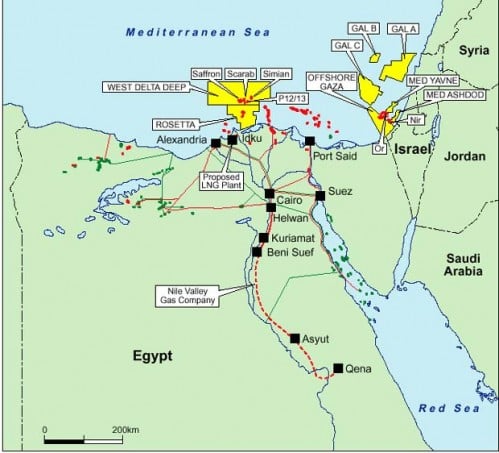
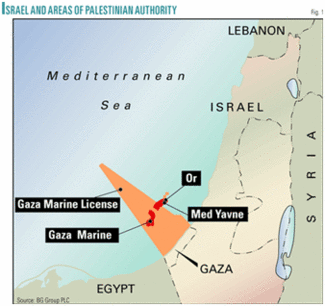
The military invasion of the Gaza Strip by Israeli Forces bears a direct relation to the control and ownership of strategic offshore gas reserves. This is a war of conquest. Discovered in 2000, there are extensive gas reserves off the Gaza coastline. British Gas (BG Group) and its partner, the Athens based Consolidated Contractors International Company (CCC) owned by Lebanon's Sabbagh and Koury families, were granted oil and gas exploration rights in a 25 year agreement signed in November 1999 with the Palestinian Authority. The rights to the offshore gas field are respectively British Gas (60 percent); Consolidated Contractors (CCC) (30 percent); and the Investment Fund of the Palestinian Authority (10 percent). (Haaretz, October 21, 2007). The BG licence covers the entire Gazan offshore marine area, which is contiguous to several Israeli offshore gas facilities. (See Map below). It should be noted that 60 percent of the gas reserves along the Gaza-Israel coastline belong to Palestine. The BG Group drilled two wells in 2000: Gaza Marine-1 and Gaza Marine-2. Reserves are estimated by British Gas to be of the order of 1.4 trillion cubic feet, valued at approximately 4 billion dollars. These are the figures made public by British Gas. The size of Palestine's gas reserves could be much larger.
Map 2 Who Owns the Gas Fields The issue of sovereignty over Gaza's gas fields is crucial. From a legal standpoint, the gas reserves belong to Palestine. The death of Yasser Arafat, the election of the Hamas government and the ruin of the Palestinian Authority have enabled Israel to establish de facto control over Gaza's offshore gas reserves. British Gas (BG Group) has been dealing with the Tel Aviv government. In turn, the Hamas government has been bypassed in regards to exploration and development rights over the gas fields. The election of Prime Minister Ariel Sharon in 2001 was a major turning point. Palestine's sovereignty over the offshore gas fields was challenged in the Israeli Supreme Court. Sharon stated unequivocally that "Israel would never buy gas from Palestine" intimating that Gaza's offshore gas reserves belong to Israel. In 2003, Ariel Sharon, vetoed an initial deal, which would allow British Gas to supply Israel with natural gas from Gaza's offshore wells. (The Independent, August 19, 2003) The election victory of Hamas in 2006 was conducive to the demise of the Palestinian Authority, which became confined to the West Bank, under the proxy regime of Mahmoud Abbas. In 2006, British Gas "was close to signing a deal to pump the gas to Egypt." (Times, May, 23, 2007). According to reports, British Prime Minister Tony Blair intervened on behalf of Israel with a view to shunting the agreement with Egypt. The following year, in May 2007, the Israeli Cabinet approved a proposal by Prime Minister Ehud Olmert "to buy gas from the Palestinian Authority." The proposed contract was for $4 billion, with profits of the order of $2 billion of which one billion was to go the Palestinians. Tel Aviv, however, had no intention on sharing the revenues with Palestine. An Israeli team of negotiators was set up by the Israeli Cabinet to thrash out a deal with the BG Group, bypassing both the Hamas government and the Palestinian Authority:
The objective was essentially to nullify the contract signed in 1999 between the BG Group and the Palestinian Authority under Yasser Arafat. Under the proposed 2007 agreement with BG, Palestinian gas from Gaza's offshore wells was to be channeled by an undersea pipeline to the Israeli seaport of Ashkelon, thereby transferring control over the sale of the natural gas to Israel. The deal fell through. The negotiations were suspended:
Israel's intent was to foreclose the possibility that royalties be paid to the Palestinians. In December 2007, The BG Group withdrew from the negotiations with Israel and in January 2008 they closed their office in Israel.(BG website). Invasion Plan on The Drawing Board The invasion plan of the Gaza Strip under "Operation Cast Lead" was set in motion in June 2008, according to Israeli military sources:
That very same month, the Israeli authorities contacted British Gas, with a view to resuming crucial negotiations pertaining to the purchase of Gaza's natural gas:
The decision to speed up negotiations with British Gas (BG Group) coincided, chronologically, with the planning of the invasion of Gaza initiated in June. It would appear that Israel was anxious to reach an agreement with the BG Group prior to the invasion, which was already in an advanced planning stage. Moreover, these negotiations with British Gas were conducted by the Ehud Olmert government with the knowledge that a military invasion was on the drawing board. In all likelihood, a new "post war" political-territorial arrangement for the Gaza strip was also being contemplated by the Israeli government. In fact, negotiations between British Gas and Israeli officials were ongoing in October 2008, 2-3 months prior to the commencement of the bombings on December 27th. In November 2008, the Israeli Ministry of Finance and the Ministry of National Infrastructures instructed Israel Electric Corporation (IEC) to enter into negotiations with British Gas, on the purchase of natural gas from the BG's offshore concession in Gaza. (Globes, November 13, 2008)
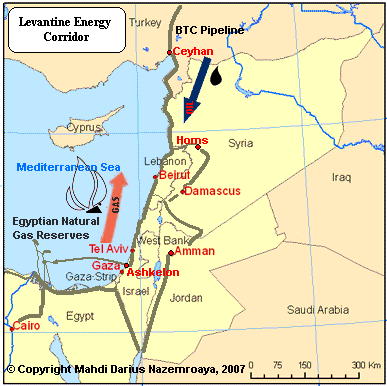
Gaza and Energy Geopolitics The military occupation of Gaza is intent upon transferring the sovereignty of the gas fields to Israel in violation of international law. What can we expect in the wake of the invasion? A new territorial arrangement, with the stationing of Israeli and/or "peacekeeping" troops? The militarization of the entire Gaza coastline, which is strategic for Israel? The outright confiscation of Palestinian gas fields and the unilateral declaration of Israeli sovereignty over Gaza's maritime areas? If this were to occur, the Gaza gas fields would be integrated into Israel's offshore installations, which are contiguous to those of the Gaza Strip. (See Map 1 above). These various offshore installations are also linked up to Israel's energy transport corridor, extending from the port of Eilat, which is an oil pipeline terminal, on the Red Sea to the seaport - pipeline terminal at Ashkelon, and northwards to Haifa, and eventually linking up through a proposed Israeli-Turkish pipeline with the Turkish port of Ceyhan. Ceyhan is the terminal of the Baku, Tblisi Ceyhan Trans Caspian pipeline. "What is envisaged is to link the BTC pipeline to the Trans-Israel Eilat-Ashkelon pipeline, also known as Israel's Tipline." (See Michel Chossudovsky, The War on Lebanon and the Battle for Oil, Global Research, July 23, 2006)
| |
Subscribe to:
Posts (Atom)